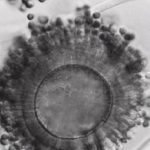
MICROBE magazine features Baudoinia
Published: August 4th, 2009
Revised: September 11th, 2009
The March 2009 issue of MICROBE magazine, the news publication of the prestigious American Society for Microbiology, included a feature article by noted international science writer and former editor of Nature Biotechnology, Dr. Bernard Dixon, summarizing our recent work on the newly described, ethanol-loving fungal genus Baudoinia.

View the full PDF article >
Trehalose accumulation in Baudoinia compniacensis
Published: May 19th, 2009
Revised: August 4th, 2009
Abstract
Baudoinia compniacensis is a microfungus recently described as the principal agent of fouling known as “warehouse staining”, affecting building exteriors, fixtures and vegetation surfaces in areas proximate to distillery aging warehouses, commercial bakeries and other areas subject to low-level ethanol vapour exposure. The surfaces most affected tend to be highly exposed and undergo extreme diurnal temperature fluctuations. In previous work, we have demonstrated the existence of heat-inducible putative chaperone proteins that may also be induced by low-level exposures to ethanol vapour (e.g., <10 ppm). The present study investigated the cellular accumulation of trehalose, a disaccharide identified in some microorganisms to be important in the protection of cell components during adverse stress conditions, such as thermal stress. Following heat shock at 45 °C, we observed a 2.5-fold accumulation of trehalose relative to unheated controls maintained at 26 °C. Peak trehalose concentrations of 10 mg/g dry wt were seen at 90 min after heat treatment, followed by a gradual return to post-treatment by 150 min. Exposure of B. compniacensis cells to ethanol resulted in a similar increased accumulation of trehalose compared to unexposed controls. These findings imply that trehalose may be important in the tolerance of this fungus to abiotic stresses, such as heat and solvent exposure, and suggest future research directions for the control and prevention of warehouse staining.
View the full PDF article >
Indoor environment survey of Penicillium brevicompactum and P. bialowiezense
Published: June 23rd, 2008
Revised: August 4th, 2009
Abstract
We investigated the diversity of the Penicillium brevicompactum Dierckx group in dust from 54 houses in Wallaceburg, Ontario, Canada. Two taxa were predominant, P. brevicompactum and Pencillium bialowiezense Zaleski, accounting for 88.6% and 5.4% of the sample set, respectively. We further characterized multilocus haplotypes of iso- lates by characterizing three polymorphic genetic loci, β-tubulin (benA), histone 4 (his4A), and the internal transcribed spacer regions of ribosomal DNA (nucITS) amplified by PCR amplification and screened using heteroduplex mobility assay (HMA). Eight unique haplotypes were observed in P. brevicompactum s. str., and two in P. bialowiezense, both with a distribution characteristic of a predominantly clonal reproduction mode. Phylogenetic analysis of the β-tubulin and nucITS loci were carried out for members of the P. brevicompactum group, including ex-type material, that revealed three well-supported lineages corresponding to P. brevicompactum, P. bialowiezense (=Penicillium biourgeianum Zaleski), and Penicillium neocrassum R. Serra & S.W. Peterson. The mycophilic nature of many isolates of P. bialowiezense, and some isolates of P. brevicompactum, suggests that observation of members of the P. brevicompactum group in indoor environments may predict extensive and longterm fungal colonization. We also address some nomenclatural problems in the group and epitypify P. bialowiezense.
View the full PDF article >
Sampling duration and recovery of culturable fungi
Published: May 3rd, 2008
Revised: August 4th, 2009
Abstract
The influence of sampling duration on recovery of culturable fungi was compared using the Andersen N6 and the Reuter Centrifugal Sampler (RCS). Samplers were operated side-by-side, collecting 15 samples each of incrementally increasing duration (1–15 min). From 270 samples collected, 26 fungal genera were recovered. Species of Alternaria, Aspergillus, Cladosporium, Epicoccum, Penicillium and Ulocladium were most frequent. Data adjusted to CFU/m³ were fitted to a Poisson regression model with a logarithmic link function and evaluated for the impact of sampling time on qualitative and quantitative recovery of fungi, both as individual taxa and in aggregate according to xerotolerance. Significant differences between the two samplers were observed for xerotolerant and normotolerant moulds, as well as Aspergillus spp. and Cladosporium spp. With the exception of Cladosporium spp., overall recoveries were higher with the RCS. When the Andersen N6 was used, the recovered levels of Cladosporium spp. and unidentified yeasts were reduced significantly at sampling times over 6 min. Similarly, when the RCS was used, recovery of Aspergillus spp., Penicillium spp., Ulocladium spp., unidentified yeasts, and low water activity fungi declined significantly at sampling times over 6 min.
View the full PDF article >
The Distilleries’ Shadow: A summary of knowledge about Baudoinia, the warehouse staining fungus
Published: May 1st, 2008
Revised: August 18th, 2009
During the 1870s, the pharmacist Antonin Baudoin called attention to a black, soot-like growth on buildings near spirit maturation warehouses in the famous town of Cognac, France. The nature of the dark “cryptogamic plant” growing on walls, roof tiles, tree trunks and fences was debated by the experts: was it a fungus or a blue-green alga? In 1881, it was definitively classified as a fungus and named Torula compniacensis (meaning ‘the torula from Cognac,’ popularly known as “la torule” in Cognac itself. The old genus name Torula, from 1794, means “little rounded thing.”). Then, remarkably, the fungus was forgotten by science for 80 years. It was briefly studied by Scandinavian and French researchers in the 1960s, then forgotten again. Finally, in the late 1990s, when the public became aware of health problems associated with the growth of black moulds in water-damaged buildings, the widespread occurrence of soot-like fungal growth around distilleries attracted attention and aroused suspicion. 
The nature of the fungus, however, baffled modern experts: ordinary culturing techniques as well as the most modern genetic sampling techniques were confounded by a dusting of ubiquitous, contaminating “weed” fungi that accumulated on top of the primary black growth. Eventually, the problem was solved by using very patient culturing with an unusual twist: since the fungus seemed to grow only where ethanol vapours were present in the air, ethanol was also added to the growth medium at low concentration. Even though the fungus was extremely slow growing, it then grew well enough to be sorted out from the overlying “weeds” and brought into pure culture.
The fungus grows as dark spots, streaks or clumps that under the microscope can be seen to be composed of short chains of dark, rounded cells. The cells have a rough wall; that and the fact that the chains break into fragments tend to make la torule look like microscopic dead debris. By comparison, the more elegantly formed cells of co-occurring “weed” fungi like Cladosporium are more likely to attract attention. To determine the biological relationship of the very nondescript torule, modern gene sequencing techniques were necessary. Remarkably, the organism was found to be most closely related to a fungal family, the Friedmanniomycetaceae, best known for growing inside porous rocks in Antarctica. Since it was completely unrelated to any fungus correctly called Torula, it had to be given a new scientific genus name. The name “Baudoinia” was chosen, after the pharmacist who first brought the fungus to scientific attention. The most typical cultures thus became the species Baudoinia compniacensis, “Baudoin’s [fungus] from Cognac.” Other, still-undescribed species of Baudoinia occur in numerous locales worldwide.
Laboratory studies have shown that B. compniacensis can use ethanol as a source of energy for growth, although it prefers to live on other, more nutritive materials. This preference is confirmed by field observations near maturation warehouses in which airborne levels of alcohol alone are typically far too low to account for the accumulated fungal mass. Baudoinia also shows a remarkable tolerance of high temperatures, not unexpectedly for a fungus growing on exposed surfaces. The temperature tolerance of the fungus is enhanced if it is exposed to ethanol first. Protein studies have confirmed that ethanol exposure stimulates the formation of protective “heat shock proteins” that confer heat resistance.
The rationale for researching Baudoinia is based on finding ways to deter its growth and, at the same time, ascertaining whether or not it has any allergenic or other health significance. Common antifungal remedies like copper and zinc salts improve short-term resistance on a range of materials, but have not enabled long-term growth deterrence. It is hoped that further studies on the organism’s physiology and genetics will provide more sophisticated remedies. Given that the actual amount of ethanol in the air in sites where the organism grows appear insufficient to support growth, further studies are also needed to determine how exactly the organism maintains its existence, and what role ethanol really plays in facilitating its growth.