Babies, pets and house dust
Published: March 16th, 2014
Revised: July 21st, 2014
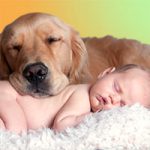 Using cutting edge high through-put DNA sequencing, Sporometrics CEO Dr. James Scott and his colleagues investigated the bacterial make-up of faeces from young babies and the homes where the babies lived.
Scott’s group found a significant overlap in bacterial communities in a baby’s faeces and dust from their home, suggesting that a baby may be sharing their gut bacteria with the environment and vice versa.
This finding may have long-ranging implications on how our environments may influence our lives. How much of a personal imprint do we leave on our home? When we move to a new home, does the microbial imprint of the former occupants have the potential to affect us? And are these effects good or bad? Sorting out these interesting questions will be the focus of Scott’s future research.
View the full PDF article >
Reference: Konya T, Koster B, Maughan H, Escobar M, Azad MB, Guttman DS, Sears MR, Becker AB, Brook JR, Takaro TK, Kozyrskyj AL, Scott JA, and the CHILD Investigators. 2014. Associations between bacterial communities in house dust and infant gut. Environmental Research 131: 25-30. doi: 10.1016/j.envres.2014.02.005.

Killing the bacteria on your cell phone
Published: February 10th, 2014
Revised: February 15th, 2014
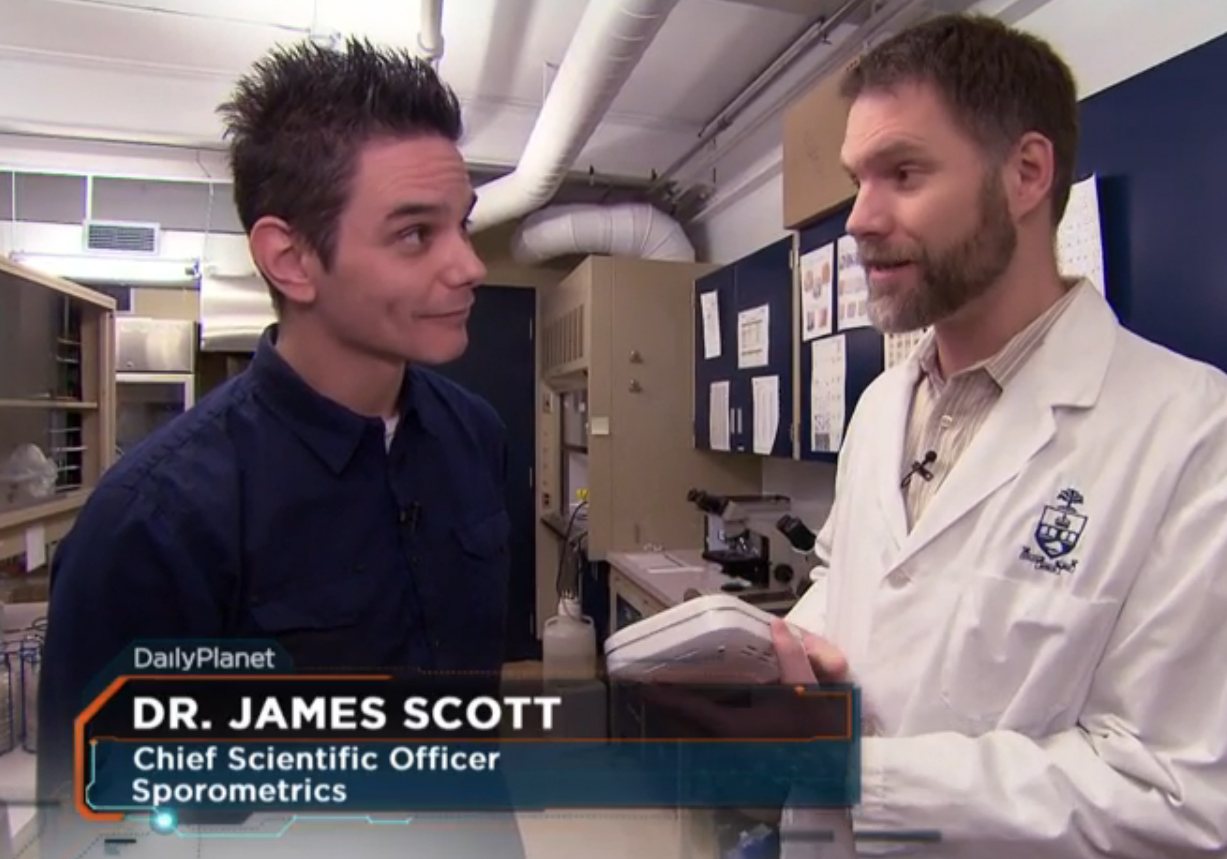 Tune in to Daily Planet February 13th, 2014 at 7 PM EDT on Daily Planet to watch James and Lucas testing out Phone Soap, a nifty, high-tech gadget that gets rid of nasty bacteria from your cell phone!
Click here to watch the full segment>
First report on the molecular identification of the phytoplasma associated with a lethal yellowing-type disease of coconut palms in Côte d’Ivoire
Published: August 8th, 2013
Revised: July 21st, 2014
Abstract
Cocos nucifera is considered the most important crop along the coastal belt of West Africa. Particularly in Côte d’Ivoire, coconut palm is cultivated on approximately 50,000 ha and produces an average of 45,000 tonnes of copra per year, which represents the main source of income for people living in the coastal region. Lethal yellowing (LY)-type diseases affecting coconut and other palm species worldwide have mostly been associated with phytoplasma strains of group 16SrIV ‘Coconut lethal yellows’. However, LY-type diseases like Cape St Paul wilt in Ghana (CSPW), the “maladie de Kaincopé” in Togo and Awka disease (Lethal Decline, LD) in Nigeria, previously included in 16SrIV group have been recently classified as a new group 16SrXXII. LY-type disease has quickly developed among coconut palms in the Grand-Lahou in Côte d’Ivoire, currently affecting more than 7000 hectares. We present the first report on the molecular identification of the phytoplasma associated with a lethal yellowing-type disease of coconut palms in Cote d’Ivoire.
View the full PDF article >
Infant gut microbiota and the hygiene hypothesis of allergic disease: impact of household pets and siblings on microbiota composition and diversity
Published: June 5th, 2013
Revised: July 21st, 2014
Background:
Multiple studies have demonstrated that early-life exposure to pets or siblings affords protection against allergic disease; these associations are commonly attributed to the “hygiene hypothesis”. Recently, low diversity of the infant gut microbiota has also been linked to allergic disease. In this study, we characterize the infant gut microbiota in relation to pets and siblings.
Methods:
The study population comprised a small sub-sample of 24 healthy, full term infants from the Canadian Healthy Infant Longitudinal Development (CHILD) birth cohort. Mothers reported on household pets and siblings. Fecal samples were collected at 4 months of age, and microbiota composition was characterized by high-throughput signature gene sequencing.
Results:
Microbiota richness and diversity tended to be increased in infants living with pets, whereas these measures were decreased in infants with older siblings. Infants living with pets exhibited under-representation of Bifidobacteriaceae and over-representation of Peptostreptococcaceae; infants with older siblings exhibited under-representation of Peptostreptococcaceae.
Conclusions:
This study provides new evidence that exposure to pets and siblings may influence the early development of the gut microbiota, with potential implications for allergic disease. These two traditionally protective “hygiene hypothesis” factors appear to differentially impact gut microbiota composition and diversity, calling into question the clinical significance of these measures. Further research is required to confirm and expand these findings.
View the full PDF article >
Pets & Microbes on Daily Planet
Published: May 1st, 2013
Revised: February 3rd, 2014
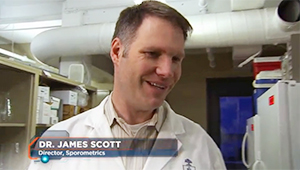 Tune in to Daily Planet April 30th, 2013 at 7 PM EDT on the Discovery Channel to watch our Sporometrics guys swabbing pets and people to find out how much of our microbiome we share with our companion creatures.
The segment, hosted by microbiologist and puppy enthusiast Dr. Jennifer Gardy from BCCDC, will feature our dogs, Aurora and Rawley, Dr. Richard Summerbell’s dog Fleefus (the best-behaved) and our protesting kitten, Tunafish Betty, along with Richard himself, Yordanka Guardiola and (a very reluctant) Ed Hollis.
Everyone had a blast, particularly the dogs. And even after a day of dog slobber, our hands remained surprisingly free of microbes!
Click here to watch the full segment>